
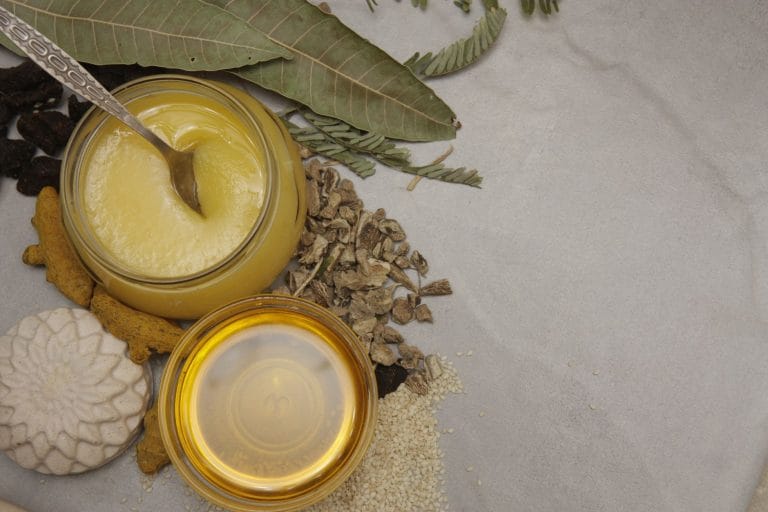
A golden kitchen staple with roots in Ayurveda, and a nutrient profile worth a closer look.
Ghee has been simmering in Indian and Middle Eastern kitchens for centuries, prized as much for its warm, nutty aroma as for its place in traditional medicine. In Ayurveda it goes by ghrita, and it turns up in everything from festival sweets to home remedies. The claims around it run wide, covering better digestion, a calmer gut, a healthier heart, and more. Some of that holds up to scrutiny, and some of it leans on tradition more than data.
This is a look at what ghee is made of, how it stacks up against plain butter, the benefits that have research behind them, and a straightforward method for making your own.
Key Takeaways
– Ghee is clarified butter, made by cooking off the water and milk solids so only the fat remains.
– It packs energy, fats, small amounts of vitamins K and B12, and trace minerals.
– Compared with butter, it carries less lactose, casein, and lactic acid, which suits some people with dairy sensitivities.
– Research links compounds in ghee to better digestion, immune support, heart health, and fat metabolism.
– Because it is calorie-dense, most guidance caps intake around 2 to 3 tablespoons a day.
What Ghee Actually Is
Ghee is simply butter that has been simmered until the water evaporates and the milk solids separate out and are strained away. What is left is a pure, shelf-stable golden fat. That extra step matters, because removing the milk solids changes how the fat behaves in the pan and how your body handles it.
What’s Inside a Spoonful
A single tablespoon delivers roughly 8.67 grams of saturated fat and 4.54 grams of unsaturated fat, so it is energy-rich by design [1]. Alongside the fat, ghee carries trace amounts of potassium, vitamin K, vitamin B12, and carotene. It shares most of its nutritional makeup with butter, with a few meaningful exceptions that come down to how it is processed.
Ghee or Butter?
The clearest difference is heat tolerance. Ghee has a smoke point near 485°F (252°C), well above butter’s 350°F (177°C), which makes it a steadier choice for frying and sautéing without scorching.
There is also a chemistry angle. Cooking certain foods at high heat produces acrylamide, a compound flagged for cancer-linked properties [2]. Ghee generates noticeably less acrylamide than several other cooking fats [3]. On top of that, straining out the milk solids leaves ghee with less lactic acid and casein than butter, so people who react to lactose often tolerate it better [4]. Neither fat is strictly “better.” It depends on what you are cooking and how your body responds.
The Benefits Worth Knowing
Digestion and the Gut
 Save
Ayurvedic tradition credits ghee with stoking agni, the digestive fire that governs how well you break down and absorb food [5]. There is a physical logic to it too: ghee is lipophilic, meaning it binds to fat molecules, and since cell walls are built from fats, that may help nutrients cross into cells. Its butyric acid also helps regulate movement through the intestinal tract, boosts mucus production, and strengthens the gut’s mucosal barrier, which keeps microbes where they belong [6].
Easing a Stubborn Cough
The evidence here is mostly traditional rather than clinical. Ghee shows up as a core ingredient in many Ayurvedic cough and cold preparations, and India’s National Health Portal lists simple cow-ghee remedies for chronic cough [7]. Treat this one as folk wisdom with a long track record rather than a proven cure.
Immune Support and Inflammation
Ghee contains conjugated linoleic acid (CLA), which in one study raised anti-inflammatory protein levels and lowered pro-inflammatory cytokines in healthy volunteers [8]. It also supplies docosahexaenoic acid, an omega-3 tied to stronger immune function [9], [10]. Those same omega-3s and butyric acid help tamp down inflammation, with butyric acid specifically shown to calm inflamed stomach and intestinal cells, a possible edge against gastric ulcers [11], [12].
Heart Health
 Save
Omega-3 fatty acids have a long, well-studied association with a healthier heart. Their anti-inflammatory action helps shield heart tissue from oxidative stress, and research connects them with a lower risk of coronary heart disease and ischemic stroke [11]. They also appear to lower blood cholesterol, easing the odds of high blood fats and hypertension [13]. CLA adds to the picture, linked with reduced oxidative stress and a lower chance of plaque building up in the arteries [14].
Weight and Metabolism
This part is less settled, but promising. Animal research found ghee lowered serum cholesterol, LDL, and triglycerides [5]. The CLA it contains has anti-adipogenic effects, meaning it may curb fat production, and butyric acid has shown a similar role in supporting fat loss [14]. Human data is still thin, so hold these findings loosely.
Skin and Hair
 Save
Ghee works as a rich moisturizer, and its vitamin E and fatty acids may improve skin texture over time. Environmental stressors like pollution and smoke generate free radicals that can damage skin and scalp, and the antioxidants in ghee may offer a small buffer. Some practitioners even dab it on minor burns, though that is anecdotal.
Where the Evidence Thins Out
A couple of the popular claims rest on very early research. Rodent studies hint that CLA might reduce insulin resistance, which would matter for people managing diabetes, but that has not been confirmed in humans. Traditional texts also recommend ghee for hemorrhoids. Both fall into the “interesting, not proven” bucket, so I would not lean on ghee for either.
Make It at Home
 Save
Homemade ghee is forgiving and needs just one ingredient: unsalted butter. Melt it slowly in a heavy pan over low heat. It will foam, then quieten as the water cooks off, and the milk solids will sink and turn golden-brown at the bottom while the fat above goes clear and amber. Strain it through cheesecloth into a clean, dry jar, and it keeps at room temperature for weeks.
Because ghee is nearly all fat, moderation is the whole game. Most guidance suggests staying within 2 to 3 tablespoons a day.
Frequently Asked Questions
Is ghee safe for people who are lactose intolerant?
Often, yes. The clarifying process strips out most of the lactose and casein, so many people with mild dairy sensitivity tolerate ghee better than butter. If your reaction is severe, check with your doctor first.
Can I cook with ghee at high heat?
That is one of its strengths. With a smoke point around 485°F, ghee handles frying and sautéing better than butter, which starts to burn at much lower temperatures.
How much ghee is too much?
Ghee is calorie- and saturated-fat-dense, so more is not better. Keeping it to roughly 2 to 3 tablespoons daily lets you enjoy the flavor and benefits without overloading on fat.
The Bottom Line
Ghee earns much of its reputation. It cooks beautifully at high heat, sidesteps some of butter’s downsides for lactose-sensitive eaters, and carries compounds like butyric acid, CLA, and omega-3s that research ties to gut, immune, and heart health. A few of its traditional uses are still waiting on solid evidence, and its calorie load means portion size matters. Used with a light hand, it is a flavorful, functional fat worth keeping around.
This article is for general information only and is not a substitute for professional medical advice. Talk to a qualified healthcare provider before making changes to your diet, especially if you have a health condition or dietary restriction.